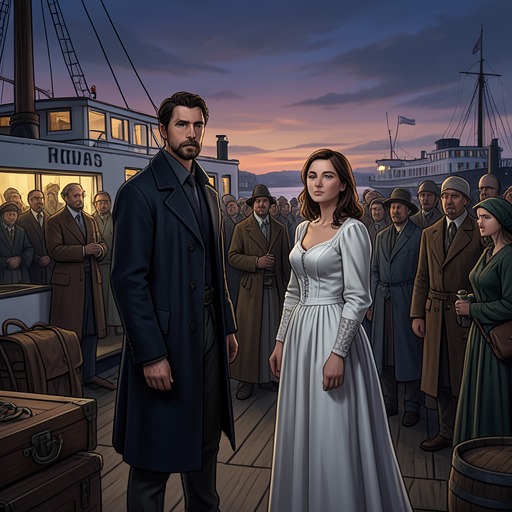
Portrait of the Intended
Heart of DarknessThe Portrait of the Intended is among the few personal objects that remain with Marlow after Kurtz’s death. More than a likeness, it becomes a material link between Kurtz’s surviving memory and The Intended’s enduring belief in him, carried from Marlow’s private possession into their final meeting. Its apparently truthful expression also sits uneasily beside the story’s repeated uncertainty about what appearances, memories, and words can disclose.
Description and Provenance
Marlow describes the portrait as a girl’s likeness, though The Intended strikes him as beautiful chiefly because of her expression. He recognizes that sunlight can deceive, yet feels that no manipulation of light or pose could have produced the delicate shade of truthfulness he sees in her features. In the image, she seems ready to listen without reservation, suspicion, or self-concern. The portrait therefore records not simply an appearance but an impression of open, trusting character—an impression that becomes important when Marlow later encounters The Intended’s confident faith in Kurtz.
The portrait is kept with a slim packet of letters. After other things associated with Kurtz have passed out of Marlow’s hands—including his body, station, plans, ivory, and career—Marlow identifies Kurtz’s memory and The Intended as what remains with him. The portrait’s place among the letters gives it a double character: it is an object to be returned, but also part of the small archive through which the dead man continues to exert a presence.
Marlow’s Decision to Return It
Marlow decides to return the portrait and letters personally. He admits that curiosity is one reason, but cannot identify the other feeling that draws him to go. He considers the possibility of unconscious loyalty, while acknowledging that he has no clear understanding of what he wants. Returning the portrait thus becomes an act whose motive remains deliberately unresolved: Marlow means to surrender what remains of Kurtz in his keeping to the past, yet undertakes that surrender himself rather than dispatching the objects anonymously.
That uncertainty recalls Marlow’s earlier difficulty in making Kurtz real before he has met him. At the Central Station, Kurtz is still largely a name associated with ivory and distant reports; Marlow even allows a young clerk to imagine that he has influence in Europe, hoping the pretense may help Kurtz. Later, Marlow reflects that no account can transmit the full lived truth of an experience. The portrait offers a visual impression where language fails, but its truthfulness is still Marlow’s perception, not proof that the image can resolve everything he does not know.
The Handover and The Intended
When Marlow visits The Intended more than a year after Kurtz’s death, she is still in mourning and receives him with a lasting faith in the dead man. Marlow lays the packet gently on a little table, and she places her hand over it. The gesture makes the returned keepsakes the immediate focus of their meeting: the portrait and letters pass from the man who has carried Kurtz’s memory to the woman who continues to mourn him.
The portrait’s trusting expression also resonates with The Intended’s manner in the scene. Marlow sees her as guileless, profound, confident, and trusting, and recognizes that she seems to experience Kurtz’s death as if it had happened only moments earlier. The likeness does not itself disclose what she believes or what Marlow knows; instead, it stands beside the living person whose grief and conviction give the returned object its emotional weight.
Narrative Significance
The portrait links appearance, memory, and the limits of truth without settling them. Marlow believes that the image carries an expression of truthfulness that lighting and pose could not manufacture, yet the wider narrative has already made him wary of what can be conveyed: the wilderness’s vast stillness exceeds easy interpretation, and he insists that the life-sensation of an era cannot be fully transmitted. The portrait is therefore neither a simple guarantee of truth nor an empty relic. It preserves an impression that matters precisely because it cannot explain Kurtz or reconcile his different legacies.
At the close of Marlow’s account, the quiet waterway lies beneath an overcast sky and seems to lead toward immense darkness. Against that unresolved ending, the returned portrait remains a small, tangible object entrusted to The Intended. It carries no final explanation of Kurtz; its significance lies in the passage of his memory from Marlow’s uncertain custody into the hands of someone whose belief and grief endure.